NJ Cannabis Compliance After the Magic Garden Botanicals Suspension: What Operators Should Learn From the NJ-CRC's October 5 Enforcement Action
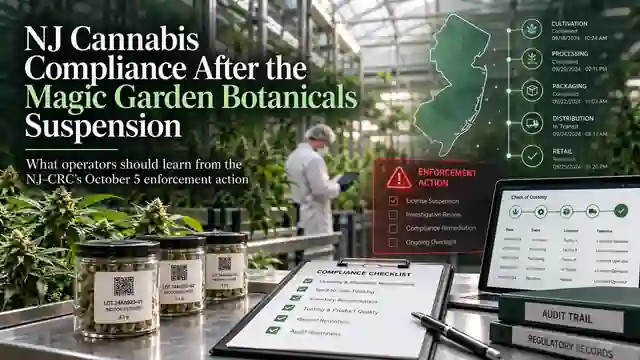
NJ Cannabis Compliance After the Magic Garden Botanicals Suspension: What Operators Should Learn From the NJ-CRC’s October 5 Enforcement Action
On October 5, 2026, the New Jersey Cannabis Regulatory Commission called a special public meeting for an enforcement action involving Magic Garden Botanicals LLC.
According to statements made during the meeting, NJ-CRC investigators conducting a routine compliance inspection discovered an unapproved and unsecured outdoor cultivation operation at the company’s Bridgeton facility.
Commission staff also cited failures involving required security measures and the tracking of cannabis plants in Metrc.
The Commission ultimately voted to suspend Magic Garden Botanicals’ cultivation license.
For New Jersey cannabis operators, the important part of this story is bigger than one cultivator.
It is a reminder of something every regulated operator should be thinking about:
What happened operationally and what the business can prove happened operationally cannot be two different things.
This Was Not a Transportation Violation
That distinction matters.
It would be inaccurate to suggest that Magic Garden Botanicals was suspended because of transportation recordkeeping.
The Commission’s stated concerns involved cultivation authorization, security, and plant tracking.
But the enforcement action still carries a broader lesson for operators responsible for moving regulated cannabis.
The NJ-CRC did not simply look at whether the company had policies.
Investigators looked at what was actually happening at the facility.
- Were the plants authorized?
- Were they secured?
- Were they entered into the required tracking system?
- Could the regulated activity be reconciled with the records that were supposed to represent it?
That same distinction exists during transportation.
There is the transfer that was supposed to happen.
And then there is the transport that actually happened.
Compliance requires the two to match.
Metrc Is Critical — but Operational Evidence Does Not End There
Metrc is the state-mandated inventory tracking system and an essential part of New Jersey cannabis compliance.
But regulated operations create information outside of Metrc as well.
A Metrc transfer can tell you important information about the regulated inventory being moved.
The actual execution of that transport can create another layer of evidence.
For example:
- Which packages were physically verified before departure?
- Did the packages loaded onto the vehicle match the transfer?
- Who released custody of the cannabis?
- Which driver and vehicle took custody?
- When did custody change?
- What route did the vehicle actually travel?
- Were required transportation conditions documented?
- When did the shipment arrive?
- Who accepted the delivery?
- Can the complete record be retrieved months later without reconstructing it from spreadsheets, text messages, emails, and separate systems?
None of this changes Metrc.
It complements the regulated inventory record with evidence of how the transport was actually executed.
That distinction becomes important when a compliance officer, auditor, investigator, or internal operations team needs to understand what happened.
A Compliance Record Is Only Useful if You Can Retrieve It
Cannabis operators generate enormous amounts of operational information.
The problem is that the evidence is often scattered.
A manifest may be in one system.
A driver’s information may live somewhere else.
Vehicle information may be stored in a spreadsheet.
GPS data may sit inside another platform.
A temperature reading may be written down.
A signature may be on paper.
Messages may be buried in somebody’s phone.
And months later, someone has to put the entire story back together.
At that point, retrieval itself becomes a compliance problem.
The question is no longer simply whether the company followed its procedure.
The question becomes:
Can you prove it?
And how long does that proof take to produce?
Compliance Should Be Created During the Operation — Not Reconstructed Afterward
The strongest compliance systems do not depend on somebody remembering to assemble evidence after something goes wrong.
They create the record while the work is happening.
A package is verified when it is loaded.
Custody is recorded when custody changes.
A driver and vehicle are tied to the run when the run occurs.
Location data is captured during the trip.
Temperature information is recorded at the appropriate points.
Receiver acceptance is documented at delivery.
And the complete history remains connected to the underlying transfer.
That creates something very different from a collection of records.
It creates a defensible operational timeline.
What October 5 Should Make NJ Operators Ask
The Magic Garden Botanicals enforcement action demonstrates that the NJ-CRC can move quickly when investigators believe an operation presents serious compliance concerns.
That does not mean every documentation gap results in a suspension.
It does mean operators should not wait for an inspection to discover that the records they believe exist cannot actually be produced.
Consider a transport completed three months ago.
Could your team immediately identify:
- The Metrc transfer
- The packages
- The shipper
- The driver
- The vehicle
- The custody events
- The GPS history
- The temperature records
- The receiver acceptance
Could you determine whether the physical packages transported matched the regulated transfer?
Could you retrieve the information in minutes?
Or would several employees need to start searching?
That difference matters.
The Bigger Lesson From October 5
New Jersey’s cannabis industry is moving out of its earliest stage.
As the market matures, regulatory scrutiny will mature with it.
Operators should expect the conversation to move beyond whether a compliance policy exists and toward whether regulated activity can actually be demonstrated.
Compliance cannot live only in a policy manual.
It has to exist in the operation.
And the operation has to leave a record.
That is the larger lesson from the October 5 enforcement action.
Not that every operator faces the same circumstances as Magic Garden Botanicals.
And not that the enforcement action involved transportation — it did not.
The lesson is that when regulated activity and regulated records stop matching, the consequences can become very real.
For cannabis transportation, the safest time to create the evidence is not when someone asks for it.
It is while the transport is happening.
How Quickly Could You Reconstruct One of Your Transports?
Flower Freight is offering New Jersey cultivators and manufacturers a Transport Readiness Review.
We’ll walk through how your team currently handles cannabis transportation and look at how quickly you could reconstruct the complete record of a historical shipment, including:
- Package verification
- Chain of custody
- Driver information
- Vehicle information
- GPS history
- Temperature records
- Receiver acceptance
- Historical retrieval
No purchasing decision required.
Just one question:
If the CRC asked for the complete record tomorrow, how ready would you be today?
Book a Transport Readiness Review